NASA Podcast – Amateur Space Radio

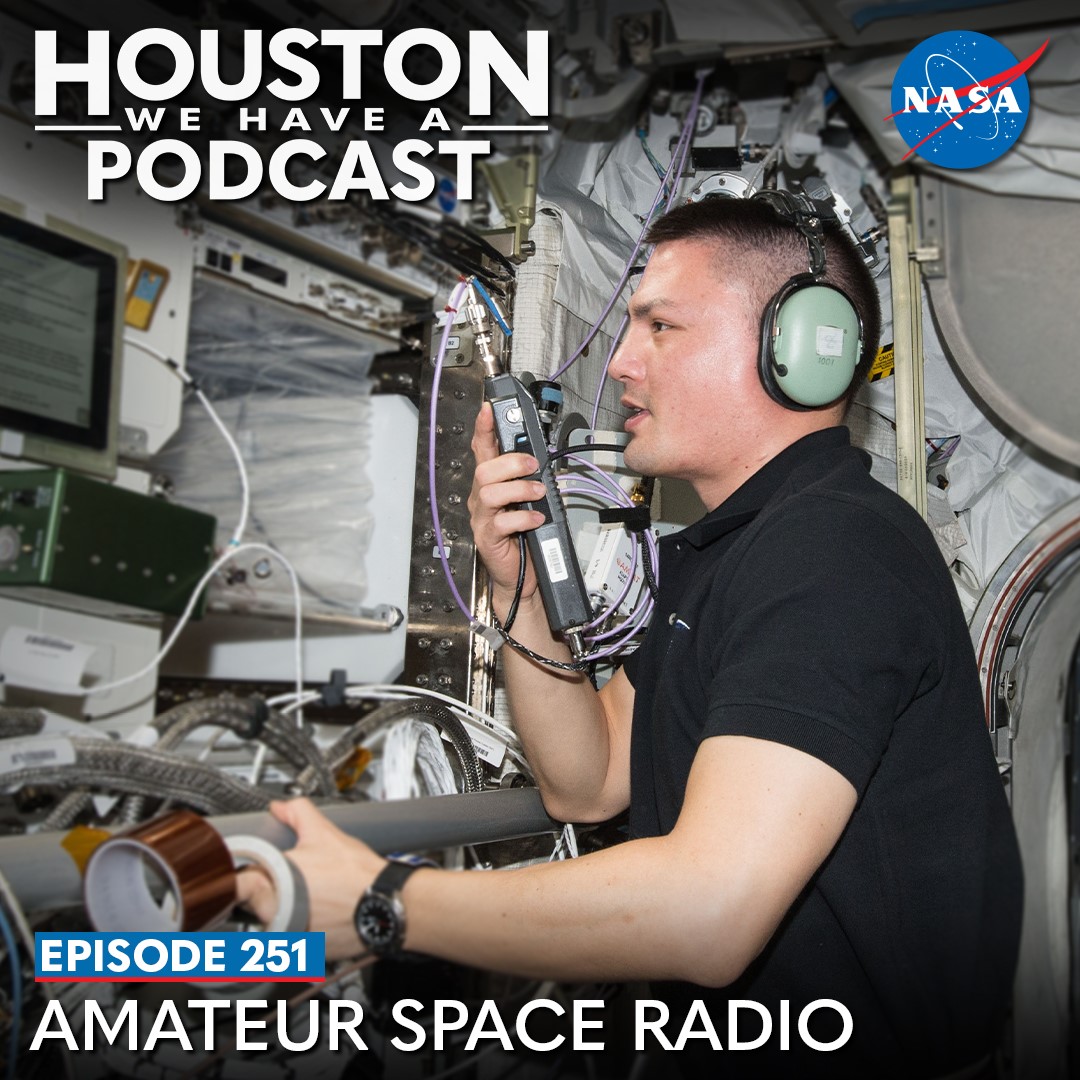
Houston We Have a Podcast - Amateur Space RadioOn Episode 251 of NASA’s Houston We Have a Podcast, Courtney Black describes the Amateur Radio program that connects astronauts in space to people and students around the globe.

This episode was recorded on May 27, 2022.

On this podcast we bring in the experts, scientists, engineers, and astronauts, all to let you know what’s going on in the world of human spaceflight. Along with jam-packed days of science and maintenance, astronauts aboard the International Space Station dedicate some time to connect with people on Earth. It can be by an IP (internet protocol) phone to call a family member, a televised event to connect with media, or even amateur radio to connect with students.

Amateur Radio on the International Space Station, or ARISS, helps create education opportunities that inspire students to pursue careers in STEM-related fields – -that’s engineering, math, science, or technology — by having the opportunity to talk to crew members on orbit. Today, we hear the story of a former teacher who has seen first-hand how ARISS communication impacts students’ lives here on Earth, and how important this program is for future generations of space explorers.

Courtney Black is an education project manager with the International Space Station U.S. National Laboratory. Before joining the National Lab, Black served as a formal educator for 14 years, educating elementary to high school students. Her passion for incorporating space education in lessons earned her recognition among her peers and allowed for students to participate in once in a lifetime opportunities, such as ARISS contacts and a downlink with the International Space Station.

Black is a Space Station Ambassador, a Solar System Ambassador, teacher liaison to the Space Foundation, Space Center Houston SEEC (Space Educator Expedition Crew) crew member, and an education, an educator member of the American Institute of Aeronautics and Astronautics and the Civil Air Patrol.

Black has presented at multiple conferences and is excited to continue presenting on topics to help bring awareness and encourage utilization of a myriad of resources available which aim to improve life on Earth through the investigation and exploration of space.

And of course, we’re very excited to have her share these resources on today’s episode of Houston We Have a Podcast. So let’s get right into it. Enjoy.

Listen to the podcast at


Source: NASA Podcast Episode 251 https://nasa.gov/johnson/HWHAP/amateur-space-radio

Get The Details…

m5aka

AMSAT-UK

Powered by WPeMatico
IARU-R1 Spectrum Regulation and Liaison Committee Slides

IARU-R1 Spectrum Regulation and Liaison Committee Report - initial slideThe Chair of the IARU Region 1 Spectrum Regulation and Liaison Committee, Barry Lewis G4SJH, took part in a joint session with the IARU-R1 Political Relations Committee (PRC) during the member society International Meeting convened during the HamRadio2022 Friedrichshafen event.

The session highlighted the connections the SRLC maintains with Region 1 regulatory bodies and the work carried out since early 2021. This included engagement in the WRC23 preparatory activities in a number of regional bodies and the detailed study work both with ITU‑R and CEPT. The hot topics affecting amateur spectrum bands were summarised with particular attention being paid to the 23cm band topic on the agenda of WRC23.

The SRLC slide set can be found at
https://www.iaru-r1.org/wp-content/uploads/2022/06/SRLC-slides.pdf

Further detailed information on the 23cm band topic can be found at
https://www.iaru-r1.org/wp-content/uploads/2022/06/23cm-Band-and-RNSS-_June2022.pdf

Source IARU Region 1 https://iaru-r1.org/

Get The Details…

m5aka

AMSAT-UK

Powered by WPeMatico

Amateur/RNSS Coexistence – 23cm Band

After review and approval by the IARU Region 1 Executive Committee and the IARU Administrative Council a presentation on preliminary Amateur / RNSS Coexistence in the 23cm band has been released.

See the presentation at
https://www.iaru.org/wp-content/uploads/2022/06/23cm-Band-and-RNSS-June2022.pdf

Source IARU
https://www.iaru.org/wp-content/uploads/2022/06/23cm-Band-and-RNSS-June2022.pdf

Get The Details…

m5aka

AMSAT-UK

Powered by WPeMatico

1240-1300 MHz: ITU-R WP5A Meeting Report

Galileo LogoIARU report on the recent meeting of ITU-R WP5A, the lead group responsible for developing the Conference Preparatory Meeting report about the WRC23 agenda item on the 23cm band.

The latest meeting of ITU-R WP5A concluded on June 2, 2022. The IARU was represented by Ole Garpstad (LA2RR – ITU Lead) and Barry Lewis (G4SJH – WRC23 AI9.1b Lead).

ITU-R WP5A is the study group at ITU which deals in part with topics related to the amateur and amateur satellite services. It is the lead group responsible for developing the Conference Preparatory Meeting (CPM) report on agenda item 9.1(b).

This Agenda Item provides for a “Review of the amateur service and the amateur-satellite service allocations in the frequency band 1240‑1300 MHz to determine if additional measures are required to ensure protection of the radionavigation-satellite (space-to-Earth) service operating in the same band in accordance with Resolution 774 (WRC‑19);” The CPM Report will form the basis for consideration of this issue at WRC-23 next year.

At the conclusion of the recent WP5A meeting a draft recommendation was prepared which will provide guidelines to administrations to ensure the protection of the RNSS primary allocation from the secondary amateur and amateur satellite services.

The draft recommendation will be the most important element of the WP5A work going forward for the amateur and amateur satellite services in the 23cm band. The working document contains a number of proposals for severe limitations on amateur usage of the band including transmitter power constraints. Very low power levels are proposed for large portions of the band (100% in one case). Proposals also identify possible frequency band usage limitations for broadband applications (e.g. ATV), narrowband applications and amateur satellite services in 1260-1270 MHz.

A full report of the WP5A meeting can be found here.
https://www.iaru.org/wp-content/uploads/2022/06/Report-from-WP5A_June-2022-FINAL.pdf

None of these proposals are adopted at this time and work will continue at the next meeting of WP5A to rationalise the variations proposed by national telecom-administrations.

The IARU will work to minimise the constraints on amateur radio activities and continue to seek amendments to the draft recommendations through the ITU process, but as a secondary user, radio amateurs should understand the need to protect the Radionavigation Satellite Service (RNSS) in many consumer and industry applications (like autonomous vehicles) that will lead to some restrictions on our use of the 23 cm band.

Get The Details…

m5aka

AMSAT-UK

Powered by WPeMatico

FUNcube-1 / AO73 Update

The Queen's Platinum Jubilee 2022Many will be aware that FUNcube-1 has been transmitting a special Fitter message to commemorate her Majesty the Queen’s Platinum Jubilee earlier this month.

Everyone who receives this message and uploads it to the Data Warehouse using the Dashboard can generate a certificate to remember this historic event. The special message includes a link to a website that has the full instructions. It is intended to keep this message active until the end of June.

The spacecraft’s orbit continues to run near the sun’s terminator and this is resulting in less than optimal solar power generation. The battery bus voltage is now centering around 7.45 volts rather than the 8+ volts that we have seen for many years. We believe that this reduced voltage level may be due to a combination of factors, illumination levels, battery and/or solar panel degradation or, possibly, gradual changes in some component values within the EPS. It is also possible that the high spin/tumble rates that we experienced over the recent months may be involved. Our thanks to to Colin VK5HI and his team for continuing to keep track of this issue for us.

Operators may have noticed that the spacecraft is now in high power telemetry mode when in sunlight and in receive only mode during eclipse. Although the transponder is not currently active, with the rapid fading presently being experienced on the downlink, the high power telemetry setting will assist listeners to decode the data more easily.

We continue to be extremely grateful to all those stations who continue to contribute their data to the FUNcube data warehouse. The information you are providing is invaluable to the FUNcube to team and will greatly assist us in managing the spacecraft through its “middle age” after more than eight years in space!

Get The Details…

m5aka

AMSAT-UK

Powered by WPeMatico